Concerns, Questions and Research
Questions to Myself
Work in Progress....Deeply questioning. Deeply animating. Deeply disturbing with no answers in the foreseeable future. Deeply disruptive. Deeply cleansing. Deeply transformative. Deeply self-correcting. Deeply encouraging 'self-death' and regeneration.
Each question is a seed. It is a package of questions. It is a question with multiple voices, a multi-vocal question. You can generate your own set of questions. Explore. And use them as a guide.
The Self and Its Shadows
• If everything I believe about myself were stripped away — the roles, the frameworks, the reputation — what would remain, and would I recognise it as something worth protecting?
• What am I most afraid to unlearn — and is that fear the truest measure of how deeply colonised my mind still is?
• Am I genuinely transformed, or have I simply learned a more sophisticated language for describing my untransformed self?
• What wound in me drives my commitment to healing the world – and have I ever looked at it directly without making it noble?
• Which of my virtues are secretly serving my ego—and how would I ever know the difference?
• If I sat in complete silence for seven days, with no ideology, no framework, no role, what would the silence say to me that my busyness has been preventing?
• What am I pretending not to know — right now, today — because knowing it fully would require me to change everything?
• Is the version of myself I am building something the Earth actually needs, or something I need the Earth to witness?
Body, Earth, and Belonging
• If the Earth is not a resource but a relative, what does my daily life reveal about how I treat my relatives?
• What does my body carry that my civilisation has declared irrelevant — and what ecological, ancestral, or somatic intelligence am I suppressing in order to function within systems that do not deserve my functioning?
• Have I ever genuinely mourned the extinction of another species — not as a concept, but as a death in my own family — and if not, what does that emotional distance cost the world?
• Whose dispossession is the foundation of the ground I stand on — and what would justice, not charity, actually require of me in response?
• When I say I love nature, do I mean I love the experience of nature, or am I willing to be accountable to it as a living community with rights and memory?
• What would it mean to live as though the forests, rivers, and soils were not the backdrop of my life but its very substance and authority?
• If the Earth were to file a legal case against my generation, what would the evidence show — and would I be a witness for the defence or the prosecution?
• Can I imagine a form of human flourishing that does not require the diminishment of any other species, and if I cannot, what does that failure of imagination cost?
Power, Privilege, and Complicity
• What is the precise, traceable human and ecological cost of the comfort I am unwilling to give up — and what do I tell myself to avoid seeing it?
• How many of my progressive commitments would dissolve if they threatened my income, my institution, or my social standing — and have I ever tested that?
• Whose epistemic authority have I systematically diminished by treating their knowledge as illustration rather than as foundation — and can I name them specifically?
• Am I fighting the system, or am I fighting for a better position within it while calling that liberation?
• What is the violence embedded in my kindness — the paternalism in my solidarity, the extractivism in my research, the colonialism in my compassion?
• If justice required me to live with materially less so that others could live with materially enough, how much less would I actually accept — and at what point would I call it sacrifice and stop?
• How has the colonial wound shaped not just what I think but also how I think — the very structures of logic, beauty, and authority I use to evaluate ideas?
• Is the institution I serve reformable, or am I lending my legitimacy to something that must be fundamentally dismantled — and whose answer frightens me more?
Leadership, Followership, and Community
• Have I ever truly followed — not strategically deferring to build trust, but genuinely surrendering the frame, the conclusion, and the credit to another's intelligence?
• What would it mean to lead from behind so completely that the community does not know they were led – and would I be at peace with that invisibility?
• Whose wisdom am I systematically not seeking because seeking it would require me to admit my own poverty of understanding?
• Is the community I am building one that can survive and thrive without me — and if not, have I been building community or building dependency?
• What is the difference between accompaniment and colonisation — and in my most honest moments, which one am I practising?
• Am I cultivating in young people the courage to contradict me, to go beyond me, to build what I cannot even imagine — or am I, however gently, replicating myself?
• What would genuine dialogical democracy demand of my ego – and have I ever submitted to a process whose outcome I could not predict or control?
• Can I hold space for a future that my frameworks cannot yet name, or do I unconsciously constrain emergence to what I already know?
Learning, Education, and the Colonised Mind
• What does the education system I inhabit systematically destroy in a child's spirit — and what am I doing to stop it, beyond critique?
• If learning is fundamentally relational, ecological, and embodied, why do I still organise it into rooms, hours, and grades — and what does my compliance with that structure reveal?
• Whose grief, whose story, whose way of knowing has been classified as superstition or irrationality to protect the supremacy of a particular civilisation's epistemology — and am I perpetuating that classification?
• What would it mean to measure education not by what a student can produce but by the quality of their relationships – with people, with the Earth, with their own interior life?
• Is the school system curable, or is the very structure of institutionalised learning the disease rather than the cure?
• What forms of intelligence — ecological, spiritual, somatic, relational, aesthetic — do cognitive monocultures actively destroy, and who bears the cost of that destruction?
• Are we educating for a world we want to preserve, or one we are too frightened to examine honestly?
• What would it feel like to learn from a river, a grandmother, a forest, and a refugee in the same week — and what would that destroy in me that needed to be destroyed?
Regeneration and What Must Die
• What in me, in my community, in my civilisation must genuinely die — not be reformed, not be reimagined, but composted — and am I brave enough to stop grieving what never deserved to live?
• Is the ecological crisis a punishment, a consequence, or an invitation — and does my answer to that question determine whether I can respond regeneratively or only defensively?
• What is the difference between hope and denial in the face of ecological collapse — and am I certain which one I am practising?
• Can I imagine a form of abundance that avoids creating a sacrifice zone elsewhere on Earth, and if not, am I genuinely working toward regeneration or just a greener version of extraction?
• What would a regenerative economy actually demand of every living person — and why are we not having that conversation at the scale and urgency it requires?
• What does genuine repair look like for a broken ecosystem, a fractured community, or violated people — and does it require the perpetrators to suffer consequences proportional to their actions?
• Is my generation mourning the world's losses deeply enough to transform itself — or are we processing grief as content and calling it activism?
• What would it mean to succeed not at saving the world, but at becoming worthy of the world that is trying to save itself through us?
Spirituality, Meaning, and the Sacred
• Is my spiritual practice genuinely confronting the structures that produce suffering, or is it making me more serene in the face of injustice and therefore more useful to power?
• What would it mean to practise non-violence not just in action but in thought, in economic choice, and in the systems I sustain with my participation?
• If the sacred is everywhere, why do I act as if it is elsewhere — after the meeting, project, or crisis?
• What is the difference between transcendence and escape, and have I, in my most honest moments, sought one while performing the other?
• Can love — not sentiment, but the fierce, disciplined, costly love that Fromm describes — actually function as a political force? And if so, why have we not organised around it?
• What does the mystic tradition know about power, suffering, and transformation that the activist tradition has not yet learnt — and what would happen if they were to genuinely merge?
• Is God, the sacred, the divine — by whatever name — found more reliably in the margins of society and the depths of ecosystems than in the centres of religious and political power?
• What would it mean to live as though every being I encounter — human, animal, plant, or river — carries the full weight of the sacred, and I am accountable to it?
Technology, Transhumanism, and the Human Future
• If the most powerful technologies of the next century are designed by a handful of corporations answerable to no community, no ecosystem, and no spiritual tradition, what precisely is being lost — and is it recoverable?
• What is the transhuman project, at its deepest level, but the oldest colonial fantasy: that the right kind of human being can transcend the conditions that govern every other form of life?
• When cognitive enhancement, genetic selection, and neural interfaces become commercially available, will disability, neurodivergence, and biological variation be treated as problems to be corrected or as forms of intelligence the species cannot afford to lose?
• If a transhuman elite develops capabilities so far beyond those of ordinary humans that empathy across that gap becomes structurally impossible, what political and spiritual frameworks do we have that could survive such a rupture?
• What does it mean to grieve the human body — its fragility, its mortality, its boundedness — not as a limitation but as the very architecture of compassion, intimacy, and wisdom?
• Can an artificial intelligence ever experience the suffering required to be genuinely wise—and if not, what does it mean that we are already outsourcing moral judgement to it?
• Is transhumanism the logical endpoint of modernity's war against nature — and if so, does resisting it require us to fundamentally re-examine everything modernity promised us?
• What does it mean to be an unenhanced, embodied, mortal, ecologically dependent human in a world where that condition has been reclassified as a problem to be solved – and is refusing enhancement an act of integrity, solidarity, or naivety?
Connecting the Dots — The Meta-Crisis
• What single pattern connects ecological collapse, democratic erosion, epidemic loneliness, spiritual vacancy, and the rise of authoritarian AI governance — and does naming it clearly enough create an obligation to act?
• Why does insight so rarely become transformation — and is the gap between knowing and doing itself the most urgent crisis of our civilisation?
• Are the most important connections in today's world being made by movements, mystics, and communities at the margins — while institutions, think tanks, and universities are connecting the wrong dots more eloquently than ever?
• What would it take — not just intellectually, but emotionally, spiritually, physically, and politically — to actually live at the intersection of all the crises simultaneously, without compartmentalising any of them?
• Is civilisation, as currently constituted, a project worth saving — or is the deepest act of love for future generations the willingness to let it compost so that something genuinely different can grow?
Legacy, Ancestry, and the Temporal Dimension
• What kind of ancestor am I becoming — not in legacy documents and monuments, but in the actual quality of the world I am leaving in the soil, the water, the bodies, and the imaginations of those who come after?
• If the children of 2076 could speak to me today, what would they beg me to stop — and what would they beg me to start — and why am I still waiting for their permission?
• What have the enslaved, the colonised, the martyred, and the disappeared given me that I am ignoring — and what do I owe them that I am avoiding?
• Is the arc of history bending toward justice on its own — or does it only bend when someone grips it at great personal cost and refuses, generation after generation, to let go? (The near-future answer: every measurable indicator suggests the arc does not bend by itself — it bends because specific people in specific moments decide it will.)
• If this is the last generation with the biological, ecological, political, and spiritual conditions required to choose a fundamentally different future, what would choosing it actually cost me, personally, today, and am I willing to pay that?
Questions for All
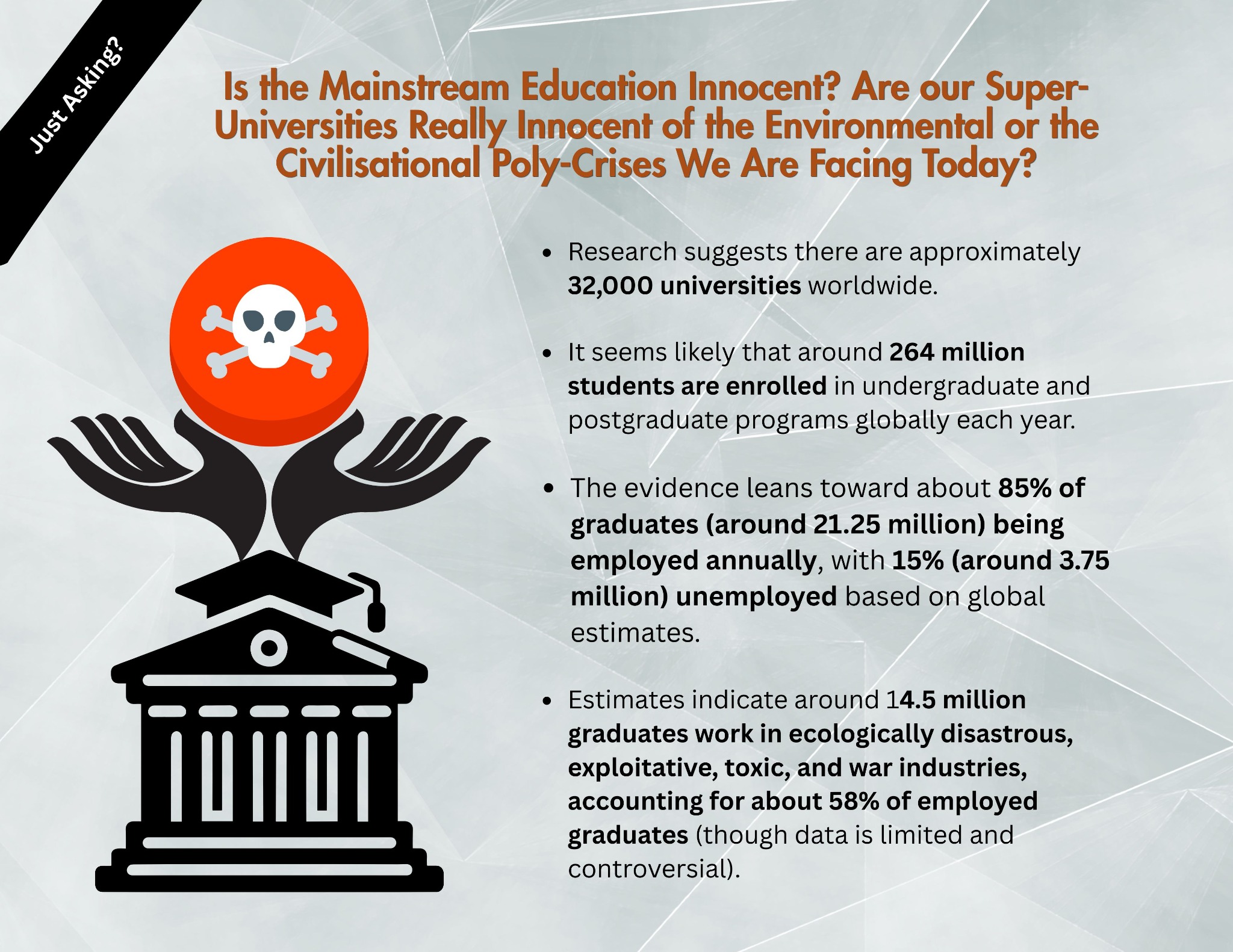
Are we part of, or beneficiaries of, the mainstream and institutionalised 'response infrastructure' that grows enormously while the crises (or polycrises) deepen? Are we genuinely committed to the transformation of a world that progressively makes us unnecessary (in a functional sense) allow all of us to flourish within and without?
(1) Despite enormous effort (including finance) locally and globally — in academia and beyond — the dangers facing people, communities, and the living world continue to grow. Our 'response infrastructure' expands enormously, yet the crises only deepen. WHY?
(2) With so many counter-hegemonic pathways, alternatives, and even an endless stream of 'solutioneers' in action with solutions, why have we made so little real difference, both locally and globally? The figures and trends only worsen. WHY?
(3) So — what are we doing wrong? Why must we change our ways? And why is that change (actually trans-formation) is so difficult? What soul-searching must we attend to? Are we genuinely prepared for this change?
Is it enough to decolonise the curriculum — or must we decolonise the very structures that determine what a curriculum is, who creates it, who teaches it, whose language it uses, what common sense it nurtures or sustains and whose future it actually serves?
'Testimonial injustice' (or the reality of credibility deficit) in a world of the 'tyranny of experts': when a marginalised person speaks from lived experience, why is their account automatically held to a higher burden of proof than that of a credentialed expert (when they have really messed up the world)?
Why do people reproduce patterns – of thought, feeling, habit, desire and action – that (i) they did not consciously choose and would often refuse if they fully understood them, or (ii) when they consumed 'packaged knowledge' that the mainstream education process delivered to them (as certificates or degrees) which they hardly questioned even after many years?